
 4.0 PRObattery · on the go
 Home 230Vfor home
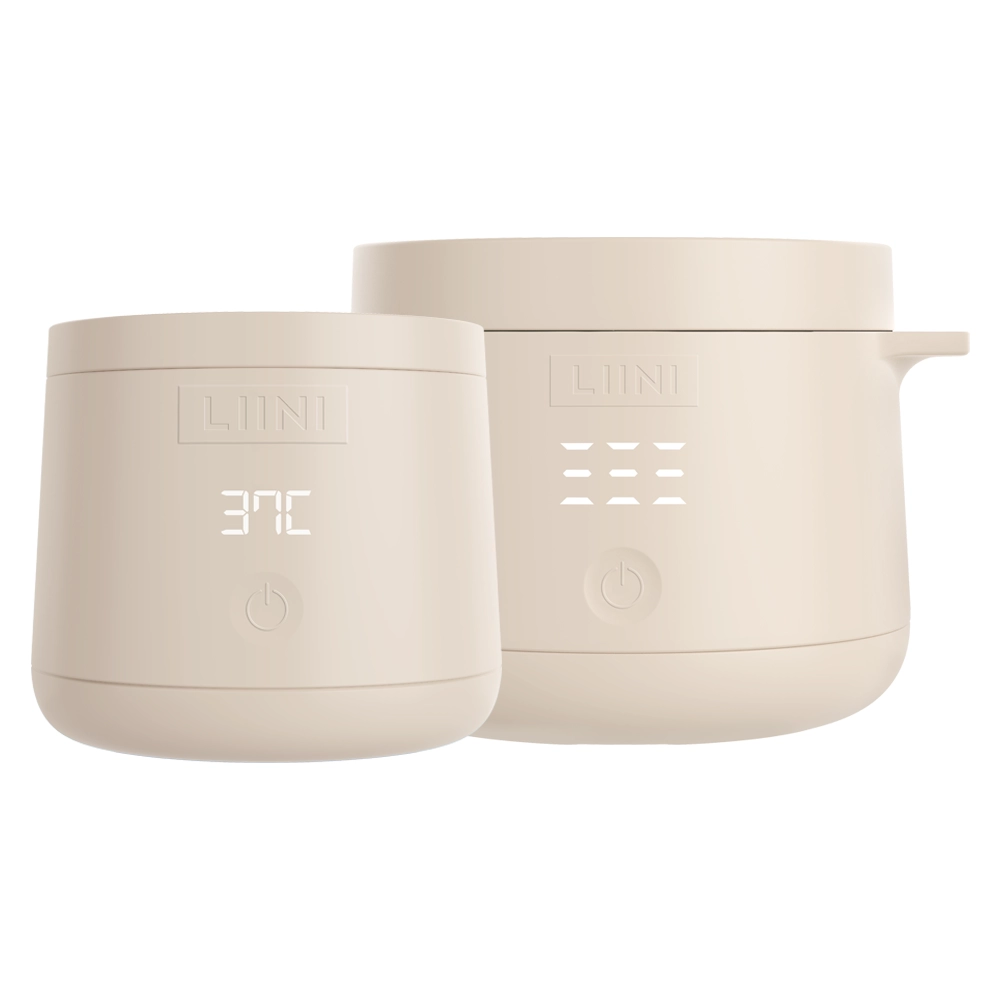
 Baby food warmersfrom 6 months
 Night Stationfor the night




 Cleaning Wipes Monthly Pack
 Home & 2Go Bundle
 Formula Dispenser Avent
 Baby Bottle Bundle











Maternity and Paternity Leave in Switzerland in 2026
14 weeks for the mother, 2 weeks for the other parent: who is eligible, how much money is available, how to apply, and what rights apply in the workplace.
Contents
In short
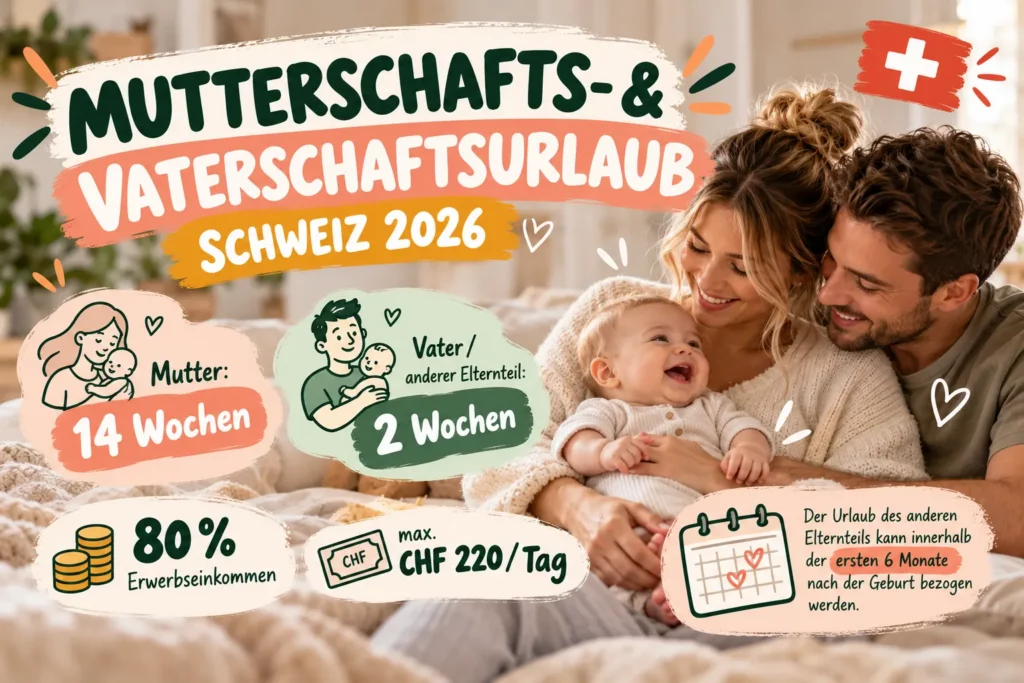
In Switzerland, you are entitled to 14 weeks of paid maternity leave after giving birth, which amounts to 98 daily benefits. The maternity allowance is 80% of your average earned income, up to a maximum of 220 francs per day (as of October 2026). The other parent—that is, the father or the mother’s spouse—is entitled to 2 weeks at the same rates and may take this time within 6 months, either as a continuous period or on a day-by-day basis. You are not allowed to work during the first 8 weeks after the birth, and after the probationary period, you cannot be terminated until 16 weeks after the birth. You must register with the AHV compensation fund; as an employee, this is usually done through your employer.
To help you focus entirely on your child during the first few weeks, federal law governs maternity leave in Switzerland and leave for the other parent. Here you’ll find out who is eligible, how much money is available, how to apply, and what rights you have at work. All amounts are current as of October 2026.
Maternity Leave in Switzerland: The Most Important Information at a Glance
| What | How long | Good to Know |
|---|---|---|
| Maternity Leave | 14 weeks from the date of birth | 80% of salary, up to 220 francs per day |
| Leave for the other parent | 2 weeks within 6 months | in one continuous period or on a daily basis, same rates |
| Prohibition on working | 8 weeks after birth | Through week 16, only with your consent |
| Protection against dismissal | Pregnancy and 16 weeks after childbirth | Applies after the probationary period ends |
| Paid Breastfeeding Leave | during the first year of life | 30 to 90 minutes per day, depending on working hours |
| Adoption leave | 2 weeks within 1 year | for children under 4 years of age, can be taken at the employee’s discretion |
Good to Know
This article provides an overview of federal law. The information provided by your AHV compensation fund—which also calculates your daily benefits—is binding.
Maternity Benefits: Who Is Eligible and How Much Do They Receive?
Who is eligible?
According to Information Sheet 6.02 of the AHV/IV, you are eligible if you:
- you were mandatorily covered by AHV for the 9 months immediately preceding the birth (in the case of a premature birth, 6, 7, or 8 months are sufficient, depending on the timing),
- were employed for at least 5 months during that period,
- and at the time of birth, you are employed, self-employed, unable to work, or unemployed. If you are unemployed, you need daily benefits from unemployment insurance or a sufficient contribution period; if you are unable to work, you need daily benefits from an insurance plan based on your previous salary.
Anyone who works for their husband’s or registered partner’s business in exchange for cash wages is also eligible. According to the Federal Social Insurance Office (BSV), if a child is stillborn, eligibility applies if the pregnancy lasted at least 23 weeks.
How much will you receive?
The benefit amounts to 80% of your average earned income prior to the birth, up to a maximum of 220 francs per day. This maximum amount is confirmed by the compensation offices’ figures for 2026. Here’s how the compensation office calculates it for employees:
You reach the maximum amount with a monthly salary of 8,250 francs or more. For self-employed individuals, the annual income is divided by 360, and 80% of that amount is used to calculate the benefit; the maximum applies for annual incomes of 99,000 Swiss francs or more. The examples are taken from Information Sheets 6.02 and 6.04:
| Calculation Example | Monthly salary: 5,250 francs | Monthly salary: 8,430 francs |
|---|---|---|
| Daily wage (wage ÷ 30) | 175 francs | 281 francs |
| 80% of that | 140 francs | 224.80 francs |
| Daily allowance (maximum of 220 francs) | 140 francs | 220 francs |
| Maternity (98 daily benefits) | 13,720 francs | 21,560 Swiss francs |
| Other parent (14 daily benefits) | 1,960 Swiss francs | 3,080 Swiss francs |
AHV, IV, and EO contributions are deducted from the daily allowance; for employees, contributions to unemployment insurance are also deducted.
Start, End, and Extension of Maternity Leave
Entitlement begins on the day of birth and ends no later than 98 days afterward. According to the Federal Social Insurance Office (BSV), there is no maternity allowance for the period before the birth. If you’re unable to work during your pregnancy, you’ll need a doctor’s note. In that case, daily sickness benefit insurance or continued pay from your employer will apply. Our due date calculator will show you when your baby is expected to arrive.
Returning to work early: If you return to work before the 14 weeks are up—even if only part-time—your entitlement ends early.
Two more weeks at home: According to ch.ch, you’re allowed to stay home for two more weeks after the 14 weeks, meaning until the 16th week. However, you won’t receive any compensation for this time.
If your baby has to stay in the hospital: If your child has to stay in the hospital for more than 14 days immediately after birth, your entitlement is extended by that amount of time, up to a maximum of 56 days. According to Information Sheet 6.02, this is contingent on you returning to work afterward. You must specify the duration in your application and include a doctor’s note.
Good to Know
According to the Federal Council, the following new rule will take effect on July 1, 2027: Maternity benefits will also be extended if the mother herself is hospitalized for at least two weeks, and the extension is no longer limited to 56 days.
If the other parent dies: If the father or the mother’s spouse dies within 6 months of the birth, your entitlement is extended by 14 days of benefits.
Application: Who files the claim and where?
Maternity benefits are not granted automatically. Here’s what you need to do as an employee:
- Inform Your Employer: Let your employer know well in advance when your due date is, and ask if they pay more than the legal minimum.
- Fill out the form. Registration form 318.750 is available at ahv-iv.ch or from your compensation office.
- Employer’s Confirmation: Your employer will certify your period of employment and salary and forward the registration to the appropriate compensation office. You can also register directly with the compensation office.
- Enclose the required documents. Include whatever the form requests. If your baby stays in the hospital longer, you’ll also need to provide a doctor’s note.
- Payment If your employer continues to pay your salary during your leave, the compensation office will transfer the benefits to your employer. Otherwise, you will receive them directly.
Self-employed individuals, unemployed persons, and women who are unable to work due to childbirth should contact their compensation office directly. You can claim this benefit up to five years after your maternity leave. The “Hospital Bag Checklist” lists what you should pack for the birth.
Prohibition on Working, Protection Against Dismissal, and Breastfeeding
Prohibition on working: You are not allowed to work during the first 8 weeks after giving birth. From the 9th to the 16th week, according to the State Secretariat for Economic Affairs (SECO), your employer may only employ you with your consent.
Protection Against Dismissal: Once your probationary period has ended, your employer may not terminate your employment during your entire pregnancy or during the 16 weeks following childbirth. Any termination during this period is null and void. If your maternity leave is extended due to a hospital stay, this protection remains in effect until the end of the extended leave. This protection does not apply during the probationary period.
Vacation: Your employer may not reduce your vacation time because of statutory maternity leave.
Breastfeeding at Work: If you continue to breastfeed, the time spent breastfeeding or pumping during your child’s first year of life counts as paid working time. According to SECO, this amounts to at least:
- 30 minutes for a workday of up to 4 hours,
- 60 minutes for more than 4 hours,
- 90 minutes for more than 7 hours.
Your employer must provide you with a suitable, hygienic space for breastfeeding or pumping—not the restroom. Breastfeeding Promotion Switzerland recommends a comfortable chair and a refrigerator for storing milk. To learn how to store expressed milk, see “Expressing and Storing Breast Milk”; to find out when health insurance covers a breast pump, see “Does Health Insurance Cover a Breast Pump?” You can find breast pumps under “Breast Pumps.”
Paternity Leave in Switzerland: Leave for the Other Parent
Officially, it is now called “the other parent’s parental leave.” Working fathers and the mother’s spouse are eligible if the spouse is legally recognized as the other parent. The same requirements apply as for the mother: 9 months of AHV coverage, including at least 5 months of employment. As the father, you must be the legal father at the time of birth or become the legal father within 6 months.
- Duration: 2 weeks; for full-time employees, 10 workdays or 14 days of benefits. For part-time employees, the amount is calculated on a pro-rata basis.
- Time limit: You must take the leave within 6 months of the birth; after that, it expires.
- In one block or day by day: According to the Federal Social Insurance Office (BSV), if you take individual days, you receive 2 additional daily benefits for every 5 compensated days.
- Amount: 80% of average earned income, up to 220 francs per day; for two weeks, this amounts to a maximum of 3,080 francs.
- Application: Through your employer or directly with the compensation office, using Form 318.747.
- Vacation and Termination: Your vacation time may not be reduced. If your employer terminates your employment before you have taken all of your vacation days, the notice period is extended.
If the mother dies: If the mother dies on the day of birth or within the 97 days following it, the other parent is entitled, according to Information Sheet 6.04, to an additional 98 days of benefits—that is, 14 weeks—paid in a single lump sum starting on the day of death.
Adoption Leave
If you adopt a child under the age of 4, you are jointly entitled to 2 weeks or 14 daily benefits. You must take them within one year of the adoption and can divide them up as you wish, but not both on the same day. The same rates apply.
To learn more about what to expect at home, read the guide “Postpartum Care, Midwives, and Health Insurance.”
Parental Leave in Switzerland: Cantons, Employers, and the Debate
According to the Federal Social Insurance Office (BSV), there is no parental leave at the federal level that parents can divide among themselves as they see fit. Federal law only establishes minimum entitlements; more is possible:
- Employers and Collective Bargaining Agreements (CBAs): Personnel regulations and collective bargaining agreements may be more generous. The Canton of Zurich, for example, grants its employees 16 weeks of paid maternity leave. Check your contract or ask the HR department.
- Cantons: They may provide for maternity leave of more than 14 weeks. Geneva currently pays 16 weeks of maternity benefits.
- Geneva Parental Leave: In June 2023, Geneva voters approved 24 weeks of parental leave—16 for the mother and 8 for the other parent. Following an amendment to federal law, the Federal Parliament gave the green light in September 2026. The start date has not yet been determined.
- Family Time Initiative: On September 30, 2026, the federal popular initiative was submitted with over 112,000 signatures. It calls for 18 weeks of paid parental leave for each parent. It is not yet clear when a vote on the initiative will take place.
Different laws apply in Germany and Austria: There, maternity leave and parental allowance—or childcare allowance—govern the period following childbirth.
Frequently Asked Questions
How long is maternity leave in Switzerland?
You are entitled to 14 weeks or 98 days of paid leave starting on the day of birth. After that, you may stay home for an additional two weeks without pay, up to the 16th week. If your baby has to stay in the hospital for more than 14 days after birth, your entitlement is extended by up to 56 days.
How much maternity allowance will I receive?
80% of your average earned income before the birth, up to a maximum of 220 francs per day (as of October 2026). As an employee, you calculate your monthly salary divided by 30, and then 80% of that amount. If your monthly salary is 8,250 francs or more, you’ll receive the maximum amount.
Can paternity leave be taken on a daily basis?
Yes. The two weeks can be taken all at once or on a day-by-day basis within six months of the birth. Be sure to coordinate the dates with your employer early on, as unused days expire.
Is there parental leave in Switzerland?
Not at the federal level—only maternity leave and leave for the other parent. Geneva has enacted its own 24-week parental leave policy, though the start date is flexible. The Family Time Initiative calls for 18 weeks each for both parents.
Can I be fired after my maternity leave?
Protection against termination applies after the probationary period until 16 weeks after the birth, or until the end of an extended maternity leave, if applicable. After that, the normal notice periods apply again. If you have any questions, legal advice can help.
Sources
- Fact Sheet 6.02 Maternity Benefits (as of January 1, 2025, PDF), AHV/IV Information Center
- Fact Sheet 6.04 Allowance for the Other Parent (as of January 1, 2024, PDF), AHV/IV Information Center
- Maternity Benefits, AHV/IV Information Center
- Adoption Allowance, AHV/IV Information Center
- Contributions, Benefits, and Threshold Amounts as of January 1, 2026 (PDF), SVA Basel-Landschaft
- Paternity Benefits, Federal Social Insurance Office (FSIO)
- Parental Leave and Leave to Care for Relatives, BSV
- When do I start receiving maternity benefits, and for how long?, BSV
- Can cantons or employers establish different rules?, BSV
- Harmonization of Income Replacement Benefits for Parents: Changes Effective July 1, 2027 (August 26, 2026), The Federal Council
- Maternity Leave, ch.ch
- Maternity Protection: General Information, State Secretariat for Economic Affairs (SECO)
- Overview of Maternity Protection Measures (June 2026, PDF), SECO
- Rights: Breastfeeding in the Workplace, Breastfeeding Promotion Switzerland
- Ordinary Termination by the Employer, Canton of Zurich
- Maternity Leave, Handbook on Employment Law, Canton of Zurich
- Reduction of Vacation Time, Info.Maternity, Travail.Suisse
- Maternity Allowance, CIFA Geneva
- Green Light for Geneva Parental Leave (September 22, 2026), watson.ch
- Family Time Initiative Submitted (September 30, 2026), zentralplus


